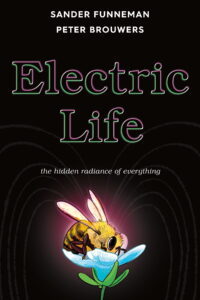
This story, which eventually led to writing the graphic novel Electric Life, started some forty years ago, when formal education had convinced me that everything in life works by chemical reactions. The physical side of life defined the truth. That’s what I believed.
Text © Sander Funneman, Illustrations © Peter Brouwers
How a lecture changed a conviction
But a lecture in 1986 shook my rock-solid conviction. The statement that was made that evening was: everything works by electricity and magnetism. Gradually, over the years, evidence started to pile up. More and more examples showed me a different side of the natural worlds. Its electro-magnetic side expanded and expanded in my mind. Surprisingly, as I went on with digging deeper into this, it became evident that not just a few curious exceptions worked by electricity and magnetism, like the electro-sensitive bill of the platypus, but that literally everything did and does.
A train trip changing a perspective
Imagine a young lady on the train from Paris to Amsterdam – or from New York to Baltimore, or from London to Leeds. All those trips take each around 3-4 hours. Let’s call this lady Tessa,
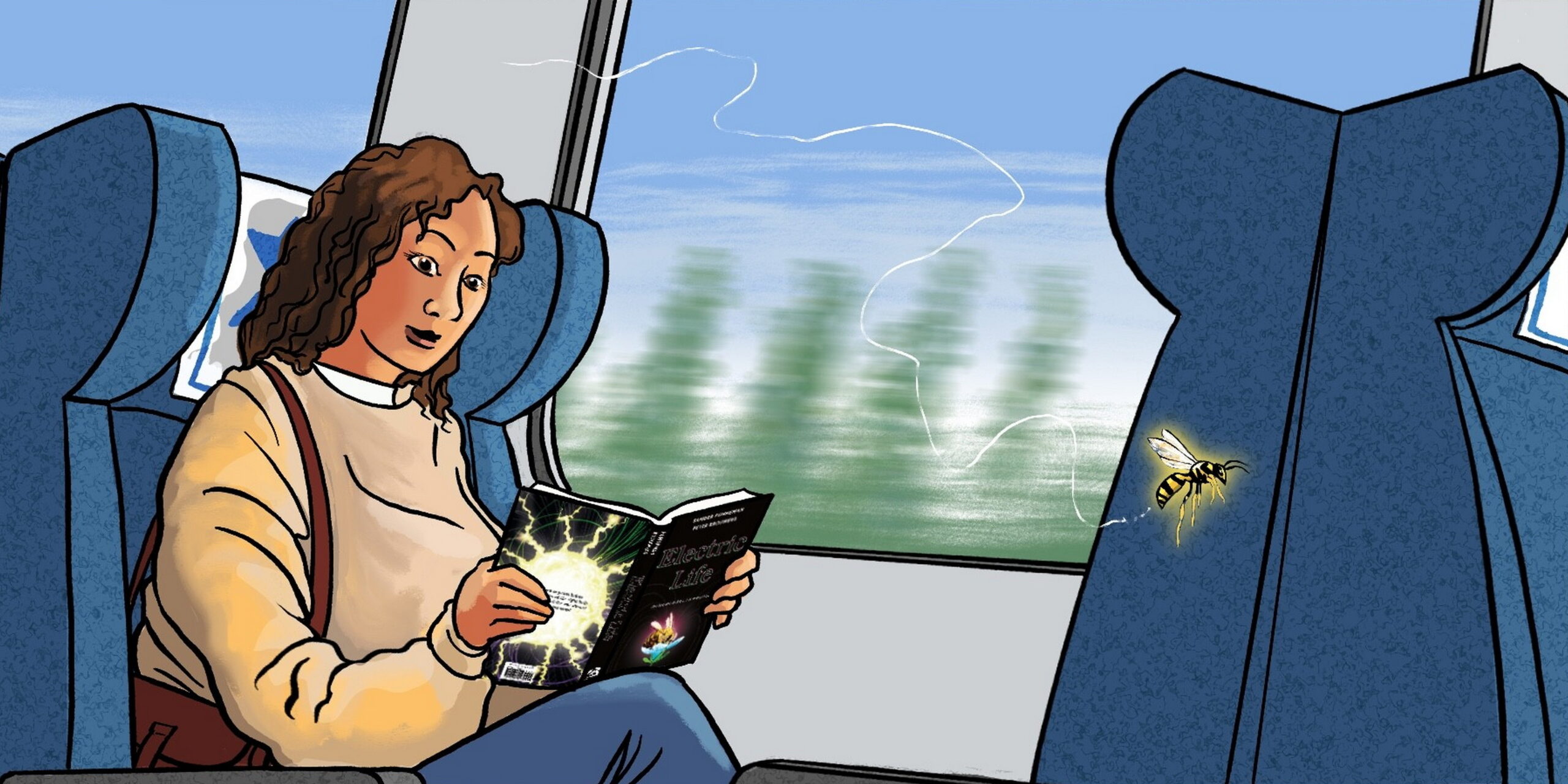
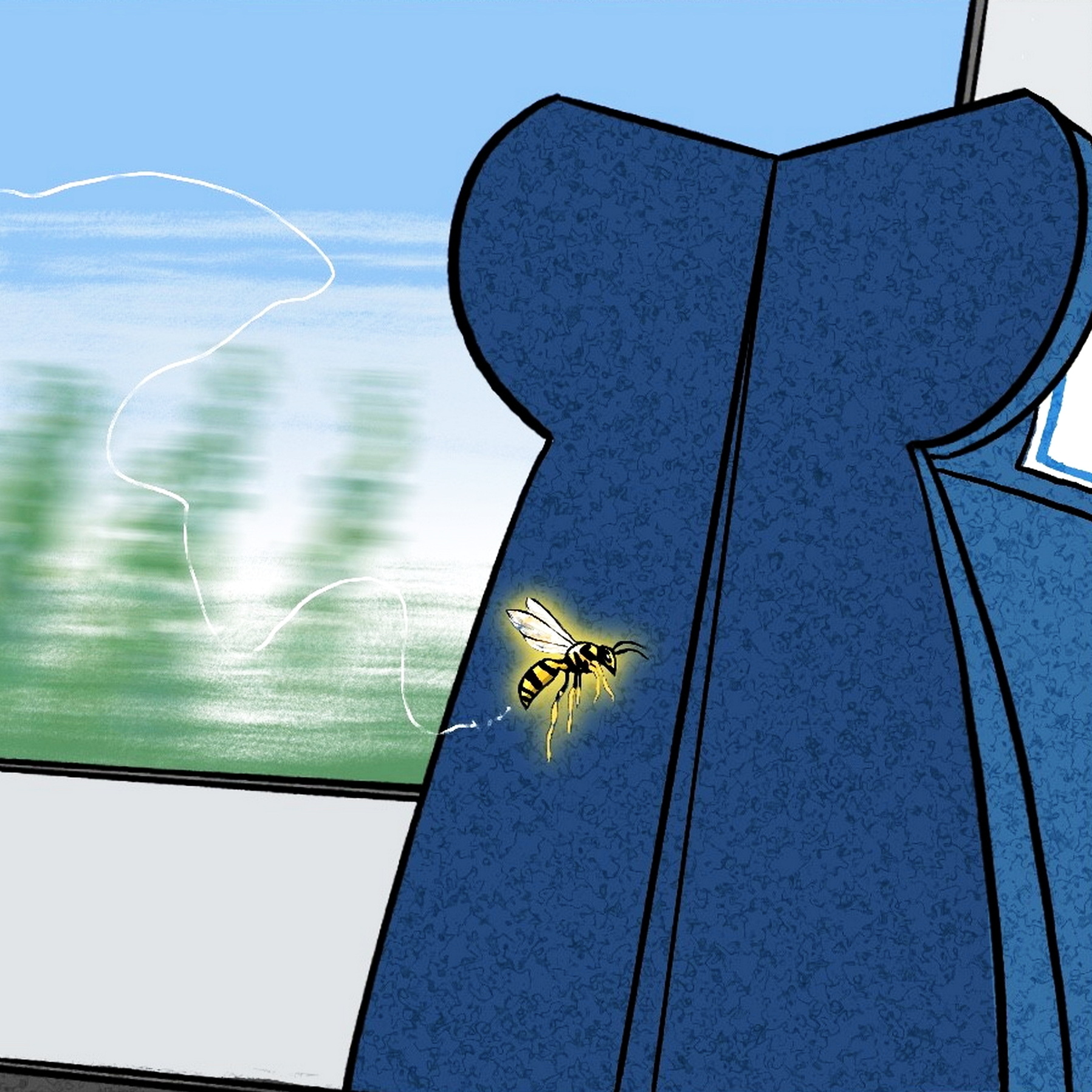
At the train station in Paris, Tessa buys the graphic novel Electric Life in a shop. She takes a seat near the window. As she lifts the book from her bag and starts reading, the train leaves the station. As she reads about the strange energetic worlds of insects, she suddenly discovers that a wasp is sitting quietly on one of the empty seats of the compartment. Instead of her usual nervousness about wasps, she feels a strange new interest in the insect. What does the wasp see that she doesn’t yet see? What does the wasp sense that she doesn’t sense?
As she continues to read about bacteria, the sky outside changes. Clouds become more dense and dark. Suddenly she sees pictures in the book of bacteria in thunderclouds and reads about how they change there, genetically, to then rain down – for example, right there on her train traveling through France.
And as she flips the page to start the chapter on ‘lightning’ in the book, the train crosses the border with Belgium. The first flashes of real lightning are filling the sky. What a curious coincidence! She sees in the book pictures of how the electric frequencies of lightning give energy and food to mushrooms and radishes, and also how lightning works with the same frequencies as her own brain…
She puts the book down and waits for another flash of lightning above the Belgium town of Tournai. She feels something. And from that day onwards, for the rest of her life, she will always stop for a moment when there is lightning in the sky, and feel how it naturally charges the air and the plants, and how it influences her body.
She continues to read about the ‘higher spheres’ and how the electric phenomena on Earth are connected to electric phenomena in the cosmos. And as the train crosses the little river La Senne, just before Brussels, she reads about the strange electromagnetic features of plants, about the way in which trees, for example form a kind of natural ‘internet’ with other trees in a forest, how trees charge the air above a forest electrically and how plants react to variations in the Earth’s magnetic field. She stares out of the window as she sees the trees along the canal that follows the train into Brussels.
Upon realizing that she has not been drinking anything during the entire trip, she grasps her water bottle. But before drinking, she looks in wonder at the water in the bottle. It looks so different. The more she looks at it, the more it seems to change. She registers it, even though she can’t put words to it yet. But she has her whole life in front of her to find out about all the electric aspects of water.
Behind Brussels the lightning stops, and just before the town of Hazeldonk the train crosses the border into the Netherlands. The clouds seem to disappear as suddenly as they came. After reading about the electric life of animals, she gazes out of the window and soon spots the V-shape of a flock of geese cruising through the air. She looks it up in the book. And yes, there they are – migratory birds flying in an electric circuit generating a lot of electricity together. Why would they do this? She looks outside again and squeezes her eyes to see if she can see it…
Later that day Tessa will arrive in Amsterdam with different eyes. She has read the book and has seen it for herself. Nothing will be the same. From now on, her disconnected physical way of observing life has been replaced by a fascinating electromagnetic way. The graphic novel will bring her many new insights that no one can even begin to foresee at this moment in time. The perspective is too young and the research is too fresh.
And so, as Tessa steps off the train at Amsterdam Central Station, the city lights seem to shimmer with a different kind of energy. She feels it—not just in her mind, but in her body, in her breath, in the subtle tingling in her fingertips. It’s as if the world around her is quietly humming a song she’s only just begun to hear.
Electric Life is not just made to be a book. It’s made to be a doorway.