This article is continuing with the amazing way in which coral reefs seem to behave as electric ecosystems, and provides ideas about how this electric side might provide keys as to how to help in saving them.
Text © Sander Funneman, Illustrations © Peter Brouwers
More on coral reefs as an electrical ecosystem
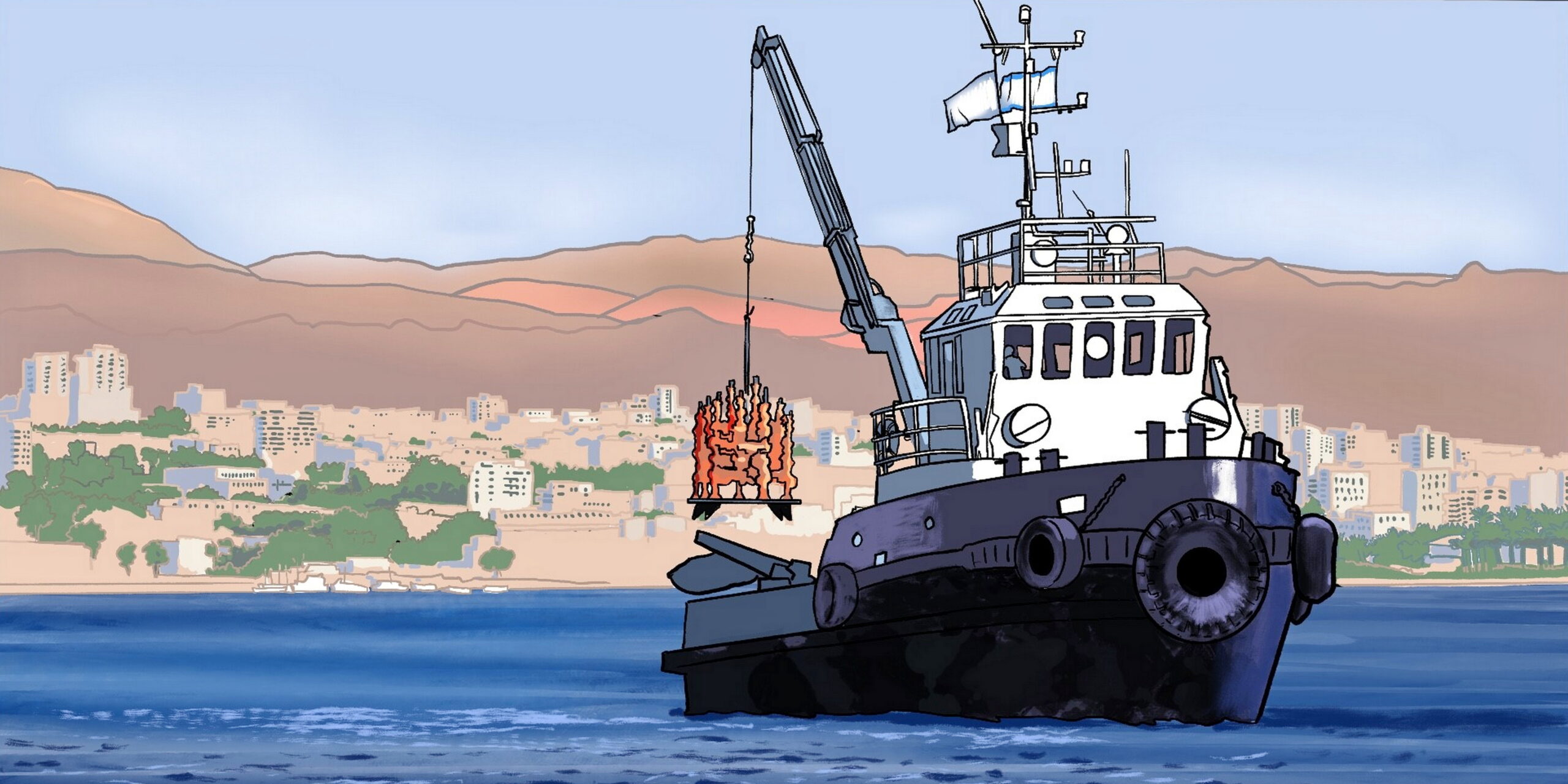
In the article Coral Reefs are Electrical Ecosystems, we discussed Prof. Ezri Terazi’s pioneering work to restore coral reefs. We brought together evidence to show that coral reefs work like an electrical ecosystem and that this endangered marine life can be surprisingly restored with a simple construction of steel and ceramics.
Around Terazi’s installation, coral began to grow rapidly and exuberantly, creating colourful communities of all kinds of fish. The article supported the idea that the reason why the coral could come to life so quickly on the steel and ceramic construction is indeed electrical; the input of electricity is amplified in some way by the construction. But…how?
We know that the oceans themselves behave like a vast electrical ecosystem, from which coral reefs feed themselves with electricity. But how does the ocean’s electricity find its way to Terazi’s installation in particular? Why does that electricity concentrate there to stimulate coral growth? It was also still a mystery why the influence of terrestrial electricity is amplified by the steel and ceramics. Until we saw the research from Boamah, et al, 2019. Here is the relevant summary of that research.
Rust and salt water
The researchers showed that a combination of rust and salt water can be used to generate electricity with an efficiency that surpasses solar panels. They showed that iron oxide can generate electricity when salt water flows over it. And that is exactly what is constantly happening in a steel/ceramic structure. In it, salty ocean water sloshes against the oxidising steel tubes. Salt water and rust – it might give a whole new way to generate electricity.
Of course, interactions between different metals or metal compounds and salt water more often generate electricity, but that is the result of a chemical reaction where one or more compounds are converted into new ones. An example is the battery.
But the phenomenon now discovered does not involve any chemical reactions at all – simply that the kinetic energy of flowing salt water across a rusty plate is converted into electricity. The rust-covered iron plates over which saltwater solutions of various concentrations flow are capable of generating several tens of millivolts and several microamperes per cm2.
This, according to Terazi, explains many phenomena in the sea. When shipwrecks start to rust, they attract all kinds of fish, even if the wrecks are in a remote area where those fish are not common. The rust on the steel of the ships seems to act as a generator and transmitter of electrical energy. When Terazi installed two smaller reefs without metal, he observed that they did not perform nearly as well as the one with the rusted steel.
The mechanism behind generating electricity essentially works as follows: the ions in the salt water attract electrons in the iron under the rust layer. When the salt water flows, so do those ions and this attraction drags the electrons into the iron, generating an electric current. The effect may explain what happens in the coral installation.
Source – Boamah, M. D., Lozier, E., Kim, J., Ohno, P. E., Walker, C., Miller, T. F., & Geiger, F. M. (2019). Energy conversion via metal nanolayers. Proceedings of the National Academy of Sciences of the United States of America, 116(33), 16210–16215. https://doi.org/10.1073/pnas.1906601116