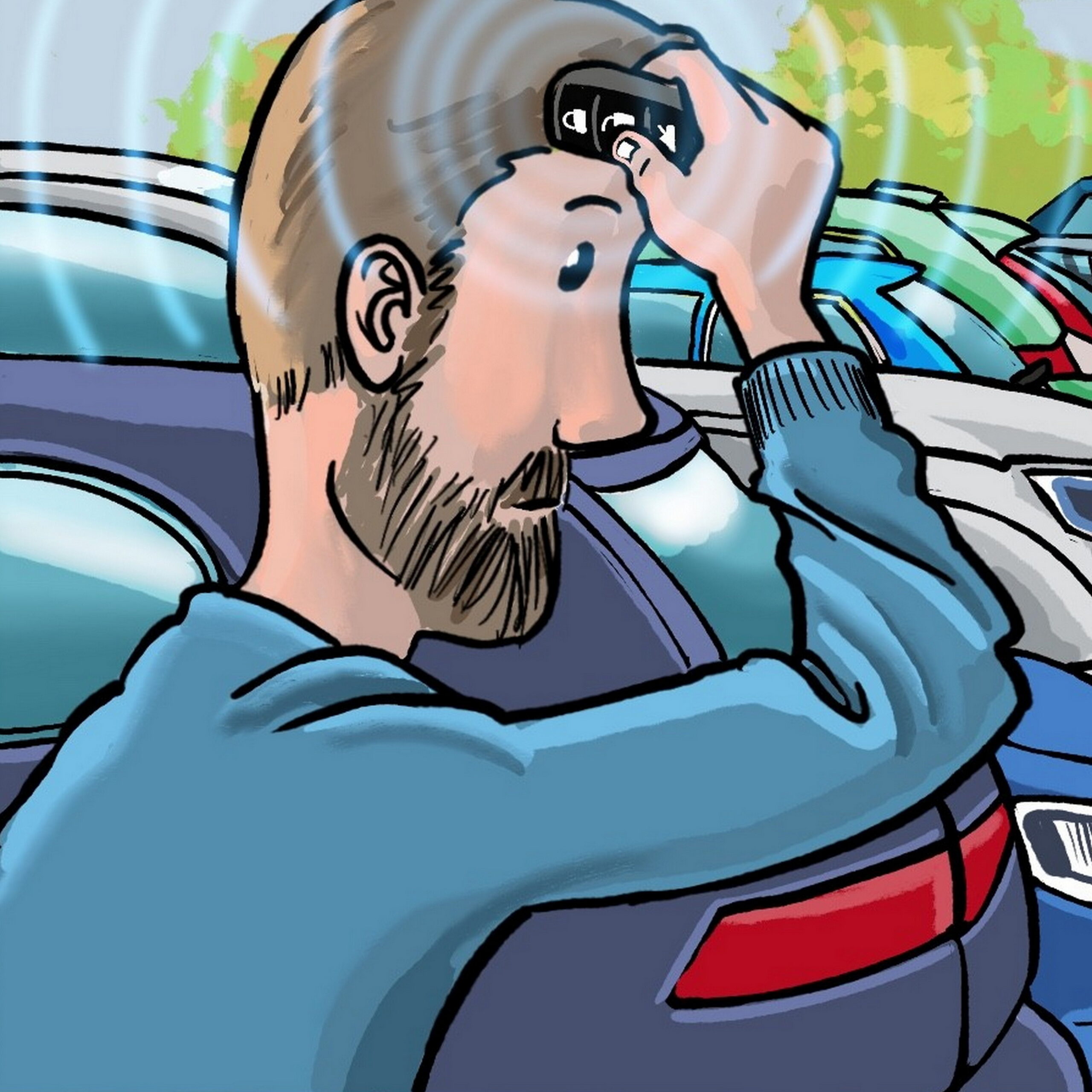
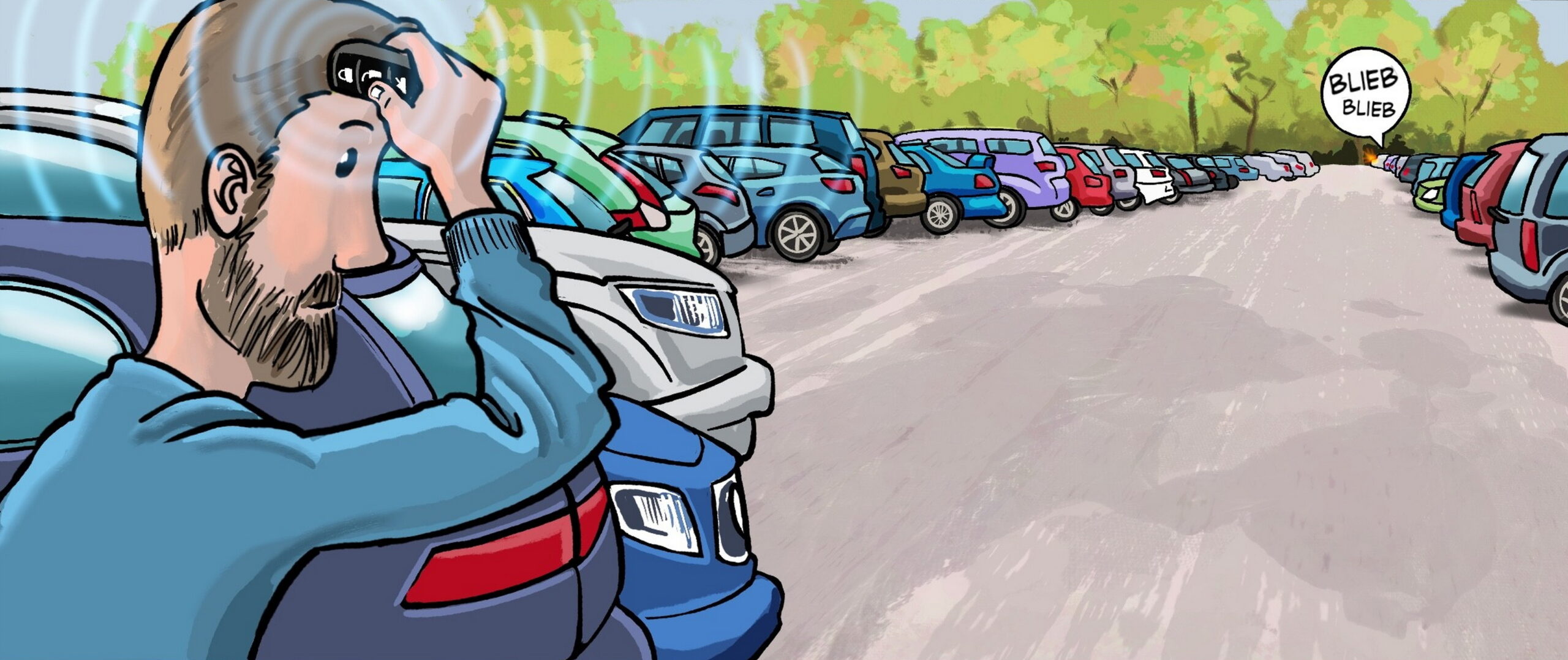
In 2014 a research was done in a car park. It revealed a fascinating phenomenon: the significant extension of the range of a car key’s remote control by simply holding the key against a human head.
Text © Sander Funneman, Illustrations © Peter Brouwers
Don’t try this at home!
In November 2014, Professor Roger Bowley conducted a survey in a car park. It revealed a fascinating phenomenon: the significant extension of the range of a car key’s remote control by simply holding the key against a human head. Roger Bowley’s head. Here is the link to the experiment:
Brain extends car key remote’s range
The normal laws of physics dictate that the remote’s range decreases as the distance from the car increases. But this study, however, shows that the remote’s range can be doubled by holding the key to the head. One aspect of explaining this phenomenon seems to be the interaction between the specific electromagnetic waves of the remote control and the water content of the human brain. This is not as strange as it seems, as both the head and water have all kinds of electromagnetic properties.
For instance, we know that the brain has both an electrical side (EEG) and a magnetic side (MEG). But the dielectric aspects of water are perhaps less well known. For instance, an electric field can be maintained in water without losing much energy, and electrically charged water droplets defy the laws of gravity by whizzing vertically upwards. Also, the evaporation rate of water increases by almost 40% after exposure to a magnetic field, and the boiling point of water decreases after magnetisation. Furthermore, water vapour absorbs electrical signals in the frequency range of 22-23 GHz and water can act as a giant battery for energy. Considering that the brain itself is largely composed of water, the question is: how do these electrical properties interact, and what is their relation to the brain’s processes?
Bowley argues that the amount of water in the brain, which makes up about 80% of its composition, plays a crucial role in amplifying the remote control signal. The electromagnetic waves emitted by the car key, which operate at specific frequencies (315 MHz in the US and 434 MHz in the EU and UK), resonate with the water molecules in the brain. According to Bowley, this resonance causes a phenomenon known as oscillation, which causes the positively charged hydrogen ions and negatively charged oxygen ions to move in opposite directions. This synchronised movement amplifies the signal emitted by the remote control.
While the research sheds light on the possible specific mechanism behind signal amplification, questions arise about the broader implications for the brain. Does the brain similarly amplify other electromagnetic frequencies present in the environment, or is the amplification frequency-specific? And, how do the brain’s processes respond to the oscillation of hydrogen and oxygen ions?
This research extends beyond the field of car key remote control and raises fundamental questions about the electrical side of life. Understanding how the brain interacts with different electromagnetic frequencies could have implications for fields ranging from neuroscience to telecommunications. The research challenges us to explore the depth of our understanding of the brain’s electrical properties and their broader impact on human cognition and health.
To understand the full scope of the brain’s response to electromagnetic frequencies, further study is needed. Questions related to the brain’s selectivity in amplification, its response to ubiquitous artificial frequencies and the possible effects on conscious and unconscious processes invite researchers to dive deeper into the electrical mysteries of the brain (and of water).
This simple and seemingly harmless experiment opens an unknown area of understanding, in which the brain, with its own intricate electromagnetic properties, is perhaps much more seriously impacted by artificial radiation than had been expected so far. As we navigate this uncharted territory, the experiment prompts us to explore not only the immediate applications, but also the profound implications for the way in which all kinds of artificial radiation in the environment is perhaps being diverted, reflected, absorbed or even magnified by the brain.
Sources of Brainpower Extends Range of Car Key Remote Control
Click the picture